

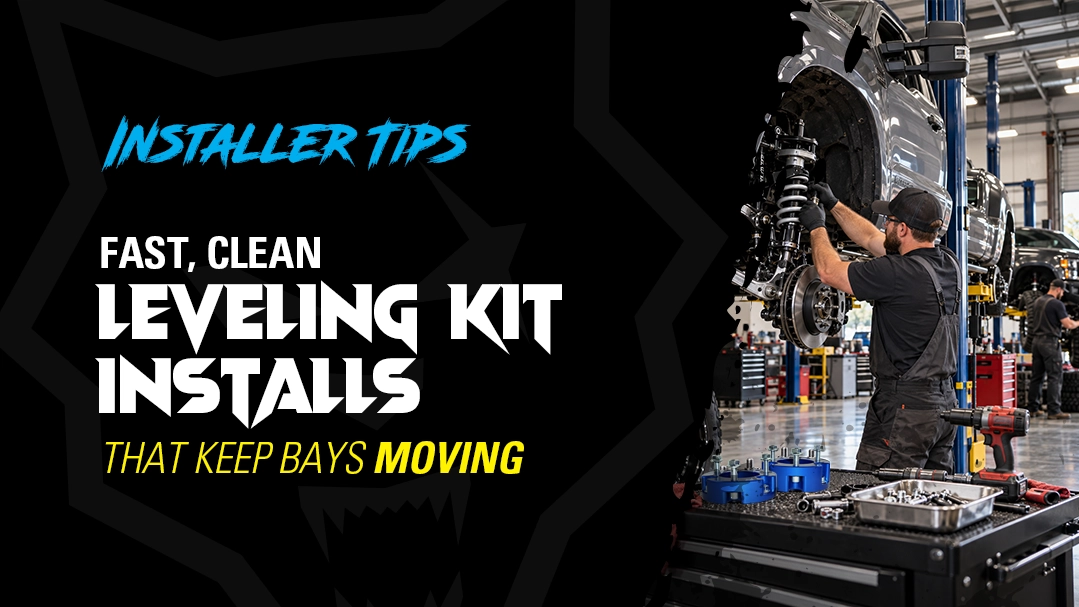
For a busy truck shop, bay time is money.
A Leveling Kit may be a relatively straightforward suspension upgrade, but wasted time hunting for hardware, dealing with avoidable fitment problems, or correcting a rushed installation can turn a profitable job into a bay-clogger.
The goal is simple: get the right parts on the right truck, install them cleanly, perform the proper final checks, and get the customer back on the road.
Pacbrake Leveling Kits are designed with that kind of installation efficiency in mind. Vehicle-specific Stage 1 kits use CNC-machined 6061-T6 aluminum components and are designed to install without strut preloading, cutting, or modification of factory-installed parts. Lift height varies by application.
Here are a few ways installers can make leveling-kit jobs faster, cleaner, and more profitable.
1. Confirm the Truck Before It Hits the Hoist
The fastest installation is the one you only have to do once. Before pulling the truck into the bay, confirm:
- Year, make, model, and drivetrain
- Correct Pacbrake kit and lift height
- Existing suspension modifications
- Aftermarket wheels and tires
- Any previous lift or leveling components already installed
A two-minute inspection at write-up can prevent twenty minutes of surprises once the wheels are off.
Pacbrake offers vehicle-specific Leveling Kits, so matching the correct kit to the truck before the job starts should be part of the shop's normal workflow.
2. Stage the Job Before the Truck Goes Up
Don't use valuable hoist time to open boxes and figure out what is inside. Have the technician or parts counter stage the job first:
Kit. Instructions. Hardware. Tools. Torque specifications.
Lay everything out before the truck enters the bay.
For shops that perform these installs regularly, creating a standard leveling-kit tool cart can save even more time. Keep the commonly needed sockets, torque wrench, pry tools, marking tools, and other installation essentials together instead of having technicians walk back and forth across the shop. Saving five minutes here and ten minutes there adds up quickly when the objective is another completed RO before the end of the day.
3. Follow the Application-Specific Installation Procedure
Experienced installers know suspensions, but familiarity can sometimes create shortcuts. Don't assume every truck comes apart, or goes back together, the same way.
Follow the Pacbrake instructions for the specific application, paying attention to hardware orientation, component placement, torque specifications, clearances, and any application-specific installation requirements.
Pacbrake Stage 1 Leveling Kits are designed around the factory suspension and do not require cutting or modification of factory-installed parts, helping keep the job straightforward. That means less fabrication, less improvisation, and a cleaner finished installation.
4. Keep the Installation Looking Factory-Clean
Customers may never see most of the components you install, but a professional shop should still make the finished job look intentional. Avoid unnecessary marks, damaged fasteners, poorly routed lines, loose wiring, or anything that looks like it was added as an afterthought.
This becomes even more important when additional suspension or air-management products are installed at the same time.
A clean installation does two things:
- It reduces potential problems for the shop
- and reinforces the value of professional installation for the customer.
That matters when you're competing against someone selling the same customer a box online.
5. Build a Repeatable Final Inspection
A fast install isn't profitable if the truck comes back.
Before handing over the keys, build a short final inspection into every leveling-kit RO. Confirm the installation against the vehicle-specific instructions, inspect surrounding components and clearances, verify hardware, and complete any required post-installation procedures such as alignment.
A few extra minutes of quality control can be far cheaper than putting the same truck back on a hoist next week.
6. Ask One Question Before Closing the RO
Here's where a basic leveling-kit installation can become a much better sale:
“Do you tow or haul with this truck?”
A Leveling Kit changes the truck's unloaded front-to-rear stance by raising the front of the vehicle. It does not provide additional rear suspension support when a trailer or heavy payload is added.
If the customer regularly tows a travel trailer, fifth-wheel, boat, equipment trailer, or loads the bed heavily, explain the difference. A truck can look perfectly level leaving the shop and still squat once several hundred pounds of tongue weight or cargo is added.
That's where Pacbrake ALPHA™ Air Suspension becomes the logical next step.
Turn a Leveling Kit Into a Complete Suspension Solution
Pacbrake ALPHA™ Air Suspension works with the truck's factory suspension to provide adjustable load support.
When properly set for the load, air springs can help reduce rear squat and maintain a more level stance while towing or hauling. And that gives the counterperson an easy conversation:
Want the truck level when it's empty?
Install the Leveling Kit.
Want it better supported when the trailer is attached?
Add ALPHA™ Air Suspension.
The products solve two different problems - and for customers who tow, they can complement each other.
Just make sure the customer understands that air springs do not increase the vehicle's GVWR, payload rating, axle rating, or towing capacity. They provide adjustable suspension support for loads that remain within the vehicle manufacturer's ratings. It is also recommended to get a wheel alignment after any adjustments to a vehicle’s height.
The Next Upsell: Make the Air Springs Easier to Use
Once a customer sees the benefit of air springs, ask another simple question:
“Do you want to adjust them manually, or from your phone?”
For customers who regularly switch between unloaded driving, trailers, campers, or different payloads, BRAVO™ Wireless Air Controls can make the system significantly easier to manage.
BRAVO™ provides smartphone or standalone remote control, real-time pressure feedback, three built-in presets, and independent or simultaneous air-spring adjustment depending on the setup. Setup Assist™ also provides system-health information, including leak-warning functionality through the mobile app.
Those presets are especially easy to demonstrate at delivery.
A customer could set one pressure for everyday driving, another for the travel trailer, and another for a heavier load. Instead of finding an external compressor and manually setting the bags every time the load changes, they can quickly return to a familiar setting.
For the installer, BRAVO™ is also designed around a clean installation. Pacbrake uses features such as push-to-connect air fittings and preassembled wiring harness connections to simplify installation. That's an upsell that adds functionality for the customer without turning the installation into an unnecessary fabrication project.
Give Customers Good, Better, Best Options
Instead of asking customers whether they want to “add anything else,” give them three clear choices.
GOOD: Level the Truck
Correct the factory front-to-rear rake and give the truck a more level stance.
BETTER: Level the Truck + Support the Load
Give the truck the unloaded stance the customer wants while adding adjustable rear suspension support for towing and hauling.
BEST: Level + Load Support + Wireless Control
Give the customer the complete setup: a leveled stance, adjustable rear load support, and easy air-spring control with pressure feedback and saved presets. That's easier for customers to understand than walking them through a shelf full of individual part numbers.
It's also a better opportunity for the shop.
Sell the Job While the Truck Is Already in the Bay
The best time to discuss suspension upgrades isn't six months later. It's when the customer has already decided to modify the truck, the vehicle is already at your shop, and you're already talking about how they use it.
- Ask what they tow.
- Ask how often the load changes.
- Ask whether the truck squats once the trailer is attached.
- Ask whether they want to manually inflate air springs every time the load changes.
Those questions can turn a simple leveling-kit install into a complete suspension and air-management package that actually matches the customer's use.
And for the shop, that's the formula that matters:
Clean installs. Fewer headaches. More value per RO. And another truck out of the bay and back on the road.