

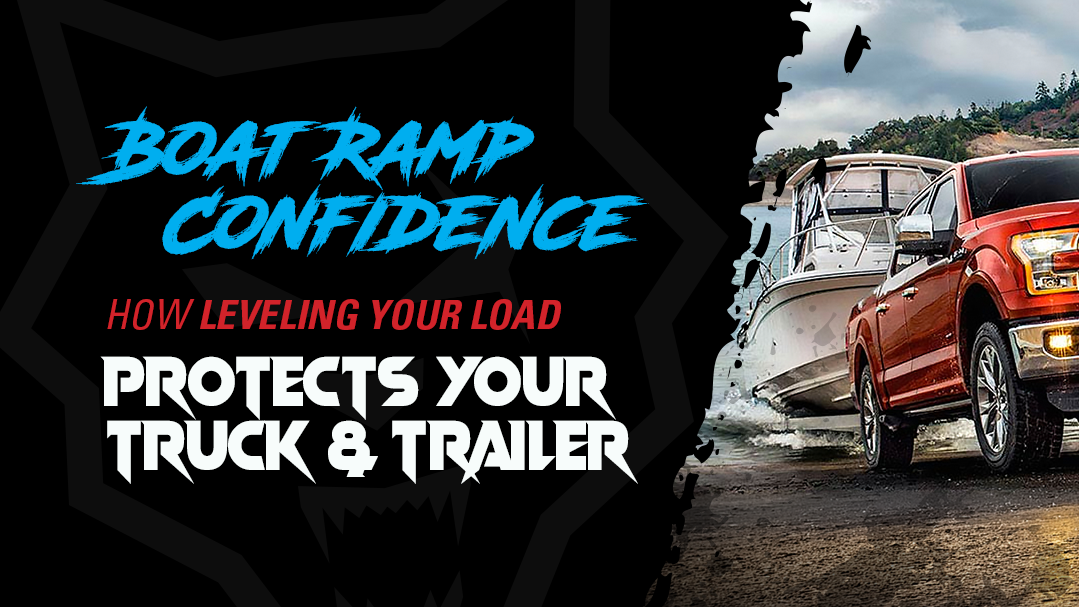
There’s a specific kind of humiliation that only happens at a boat ramp.
It’s 6 a.m. Six rigs are lined up behind you. Your truck is squatting hard over the rear axle, the trailer tongue is pointing skyward, and you’re white-knuckling the wheel while trying to back a boat you can barely see into the water.
Everyone watches. Nobody helps.
Most boat-ramp problems begin before you leave the driveway—the moment you hitch a loaded trailer to a truck that isn’t properly set up to carry the weight level.
What’s Actually Happening Under Load
Tongue weight—the downward force your trailer places on the hitch—typically equals 10 to 15 percent of the total loaded trailer weight. On a 6,000-pound boat and trailer, that could mean 600 to 900 pounds pressing down behind your truck’s rear axle.
Add passengers, fuel, coolers, tools and gear, and your factory suspension can quickly become overwhelmed.
When the rear of the truck drops, the entire tow setup changes:
Steering feels lighter. Rear-end squat can reduce weight over the front axle, making steering feel vague—especially on a steep, wet launch ramp.
Braking confidence drops. An uneven stance changes how weight transfers through the truck during braking, exactly when you need predictable control heading downhill toward the water.
Headlights aim too high. A nose-high truck can blind oncoming traffic while reducing your own view of the road.
Trailer stability can suffer. A trailer that sits nose-high may track differently and become more susceptible to instability at highway speeds.
Hitch components wear faster. Incorrect hitch height and poor trailer geometry can place unnecessary stress on the ball, coupler and receiver.
The Ramp Doesn’t Create the Problem. It Exposes It.
Every highway mile driven with a sagging rear suspension puts additional strain on your truck, tires, suspension and towing equipment.
The launch ramp simply amplifies the problem.
Steep grades, wet pavement, limited visibility and a line of impatient boaters leave little room for a truck that handles differently than expected. If your rear suspension is regularly operating near its limit, it may be time to add support before the next trip to the lake.
The Fix Isn’t Just a Weight Distribution Hitch
Weight distribution systems can be useful because they help redistribute tongue weight across the tow vehicle and trailer axles. However, they work best as part of a properly matched towing setup.
They do not restore the capability of an overloaded or under-supported factory suspension.
Pacbrake ALPHA™ Air Suspension works alongside your truck’s existing suspension to provide adjustable load support. Add air when the boat is hooked up to reduce rear-end sag and help restore a more level stance. Reduce the pressure when the truck is unloaded to maintain a more comfortable everyday ride.
That means you can adjust your suspension for the load you are actually carrying instead of relying on one fixed spring rate for every situation.
The result is a truck that sits more level, a trailer that tracks more predictably and a driver who feels more confident from the highway to the launch ramp.
Air suspension does not increase your truck’s factory GVWR, payload rating or towing capacity. It helps your truck manage permitted loads more effectively.
Don’t Stop at Air Springs
Pacbrake ALPHA™ provides the load support—but pairing it with the right Pacbrake products creates a complete boat-towing setup.
Good: ALPHA™ Air Suspension
For occasional towing, ALPHA™ Air Suspension provides adjustable rear support that can be manually inflated to match the load.
Hook up the boat, add the appropriate pressure and bring the truck back toward a level stance.
Better: Add BRAVO™ Wireless Air Controls
Boat loads rarely stay exactly the same. Fuel levels change. Coolers get packed. Gear moves between the boat and truck bed.
Pacbrake BRAVO™ Wireless Air Controls let you adjust your air spring pressure from a smartphone or compatible standalone remote. Live pressure readings and saved presets make it easy to switch between common setups such as:
- Empty truck
- Boat trailer attached
- Boat trailer plus loaded truck bed
- Full camping or fishing setup
Because BRAVO™ operates through Bluetooth, suspension adjustments can be made even at remote launches without cellular service.
No gas-station air pump. No guessing. No crawling under a loaded truck.
Best: Add DELTA™ Onboard Air
For customers who want even more capability, add a Pacbrake compressor and DELTA™ Air Tank.
A complete onboard air system gives you a convenient air source for truck and trailer tires, boat-trailer maintenance, inflatable gear and other accessories at the lake or on the road.
Instead of carrying a separate portable compressor—or hoping the nearest gas station has a working air pump—you have compressed air available directly from your truck.
Finish the Setup With a Pacbrake Ball Mount
Air suspension helps level the truck, but the trailer still needs to sit at the correct height.
Pacbrake Adjustable Locking Ball Mounts provide adjustable rise and drop positions, making it easier to match the hitch height to the trailer. Dual hitch balls also help customers who tow more than one trailer, while integrated locking pins add security when the truck is parked at the launch.
Level the truck. Level the trailer. Then verify that every component is rated for the actual load being towed.
Before Your Next Launch
Measure the truck loaded and unloaded. Measure from the ground to the rear wheel opening before and after attaching the trailer. A noticeable drop means the rear suspension may need additional support.
Check the trailer angle. The trailer frame should sit approximately parallel to the ground. A nose-high or nose-low trailer may require ball-mount adjustment.
Check your headlights. Park 25 feet from a wall or garage door and compare the beam position before and after hitching. A rising beam pattern is a clear sign of rear-end sag.
Confirm your payload. Check the label inside the driver’s door. Tongue weight, passengers, fuel and everything in the truck bed count toward available payload.
Inspect the hitch and coupler. Confirm the hitch, ball, ball mount, coupler and safety chains are properly connected and rated for the loaded trailer.
Set your air pressure. Add only enough pressure to support the load and bring the truck back toward its normal ride height. Air springs are not intended to lift the rear of the truck excessively.
Make the Boat Ramp Boring
The goal is not to build the most complicated towing setup at the lake.
The goal is to make launching uneventful.
With Pacbrake ALPHA™ supporting the load, BRAVO™ putting suspension control at your fingertips, DELTA™ providing onboard air and a Pacbrake Ball Mount helping position the trailer correctly, your truck arrives prepared before the ramp ever becomes a factor.
You back down the grade. The truck sits level. The trailer tracks cleanly. The boat goes into the water.
No drama. No audience. No white knuckles.
Level your load. Protect your equipment. And spend more time on the water—not struggling at the ramp.

