

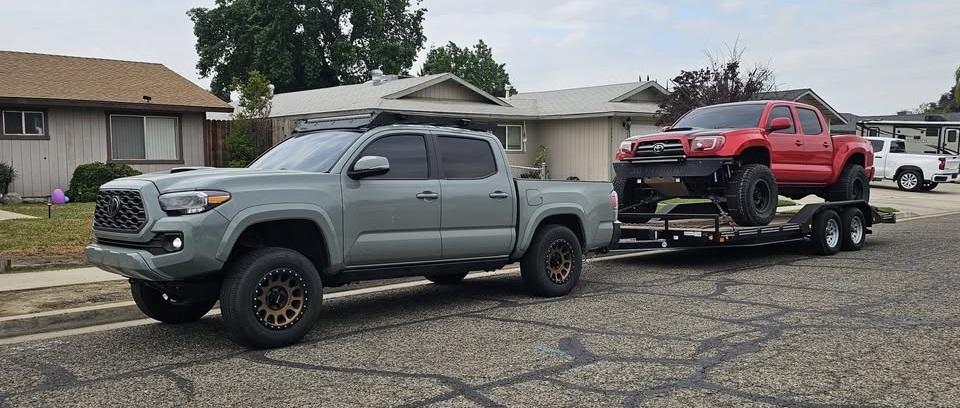
You bought a new pickup because it promised capability. Then you hooked up a trailer and suddenly your truck looked like it skipped leg day and went straight to “tired dad stance.” Don’t worry—you’re not alone, and your truck isn’t broken. It’s just under-supported.
If you’re a relatively new truck owner gearing up for the 2026 tow season, this guide walks through why sag, sway, and bottoming out happen, the best ways to fix them, and how to choose the right Pacbrake air suspension system for your exact needs.
Professional? Yes. Educational? Absolutely. Mildly judgmental of factory suspension? Just a little.
The Big Three Tow-Haul Problems (and Why They Happen)
1. Sag or Squat
- Reduced steering control
- Lengthened braking distance
- That “this doesn’t feel right” sensation
- Headlights aimed at the treetops - there is almost nothing worse, especially as you get older, than someone blinding you at night with headlights aimed directly into your retinas.
Rear sag happens when tongue weight compresses the suspension. The result:
2. Sway
Trailer sway happens when the trailer starts oscillating side-to-side because it’s unstable relative to the tow vehicle. Common triggers are too little tongue weight (trailer’s center of mass too far back) or an unbalanced/uneven load. Add wind, speed, or passing semis and sway shows up uninvited.
3. Bottoming Out
Factory bump stops aren’t meant to be ridden—they’re emergency cushions. If you’re hitting them regularly, your suspension is overloaded, and every bump is sending a message directly to your spine.
Fixing Sag, Sway & Bottoming Out: Common Options
Rubber or Foam Springs
- What they do: Replace factory bump stops with dense rubber springs
- Pros: Simple, maintenance-free
- Cons: Engage suddenly, can add stiffness even when unloaded, not adjustable to load
- Best for: Light-duty trucks with very occasional towing
Add-a-Leaf Suspension
- What it does: Increases leaf spring capacity
- Pros: Cheap, permanent payload increase
- Cons: Stiffer ride 100% of the time, zero adjustability
- Best for: Work trucks that are always loaded
Rear Block Kits
- What they do: Change rear ride height by altering axle-to-spring spacing
- Pros:
- Restore ride height on lifted trucks or those with old, sagging leaf springs
- Improve driveline angles when towing
- Help distribute load more evenly to the rear suspension
- Cons:
- Not adjustable, permanent lift to rear
- Best for: Lifted or older trucks that squat excessively when towing and consistently carry heavy loads. Check out Pacbrake’s Rear Block kits here.
Air Suspension (The Best Solution for Most Trucks)
- What it does: Adds load support only when needed
- Pros: Adjustable, restores factory ride height and geometry
- Cons: Requires adjustment (worth it)
- Best for: Anyone who tows, hauls, and still wants a comfortable daily driver
Bottom line: Air suspension doesn’t just mask the problem—it corrects it.
Why Air Suspension Works So Well
Air springs:
- Restore proper ride height under load
- Reduce sway by improving weight balance
- Prevent bottoming out before bump stops engage
- Let you fine-tune support based on real-world conditions
Think of it as giving your truck adjustable muscle instead of permanent stiffness.
Selecting the Best Pacbrake Air Suspension for Your Truck
Pacbrake’s ALPHA air suspension lineup is designed so you don’t have to overbuy—or under-support—your truck. Each option is engineered for specific load ranges and driving styles.
Pacbrake ALPHA SD (Standard Duty) – Up to 2,000 lbs
- Best for: Occasional towing and light hauling
- Ideal trucks: Daily drivers, quarter to half-tons towing small trailers or hauling light loads
- Why choose it: Prevents sag without changing ride quality when unloaded
- Typical use: Utility trailers, small campers, weekend toys
Pacbrake ALPHA HD (Heavy Duty) – Up to 5,000 lbs
- Best for: Regular towing and moderate payloads
- Ideal trucks: Half-tons and three-quarter-tons with consistent trailer use
- Why choose it: Balanced capacity for work-and-play trucks
- Typical use: Boats, mid-size travel trailers, enclosed cargo trailers, construction, landscapers
Pacbrake ALPHA XD (Xtreme Duty) – Up to 7,500 lbs
- Best for: Frequent heavy towing
- Ideal trucks: those with payloads above 7,500 lbs; remember, suspension support does not increase your payload!
- Why choose it: Higher-capacity air springs designed for demanding loads
- Typical use: Large campers, equipment trailers, toy haulers, service trucks
- What’s different: Includes a jounce bumper inside the air spring
- Why that matters:
- Acts as a built-in safety cushion if air pressure drops (or you forget to air up)
- Improves stability at low air pressures
- Adds progressive support over large bumps
- Best for: Drivers who want adjustability, safety, and peace of mind
- Ideal use: Mixed driving—daily commuting one day, heavy towing the next
- Everything in PRO, plus:
- Stainless steel air lines and fittings for maximum durability
- Why upgrade:
- Corrosion resistance in harsh climates
- Cleaner installs
- Long-term reliability for serious towing
- Best for: Premium builds, full-time towing, commercial or RV use
If the PRO is peace of mind, the PRO S is peace of mind with a polished stainless durability.
-------------
If your truck sags, sways, or bottoms out, it’s not failing—it’s asking for help. Air suspension answers that call better than any other solution, and Pacbrake’s ALPHA lineup ensures there’s a system tailored to how you actually use your truck.
Tow smarter. Ride level.

